What the Fee Is and How Apple Designed It
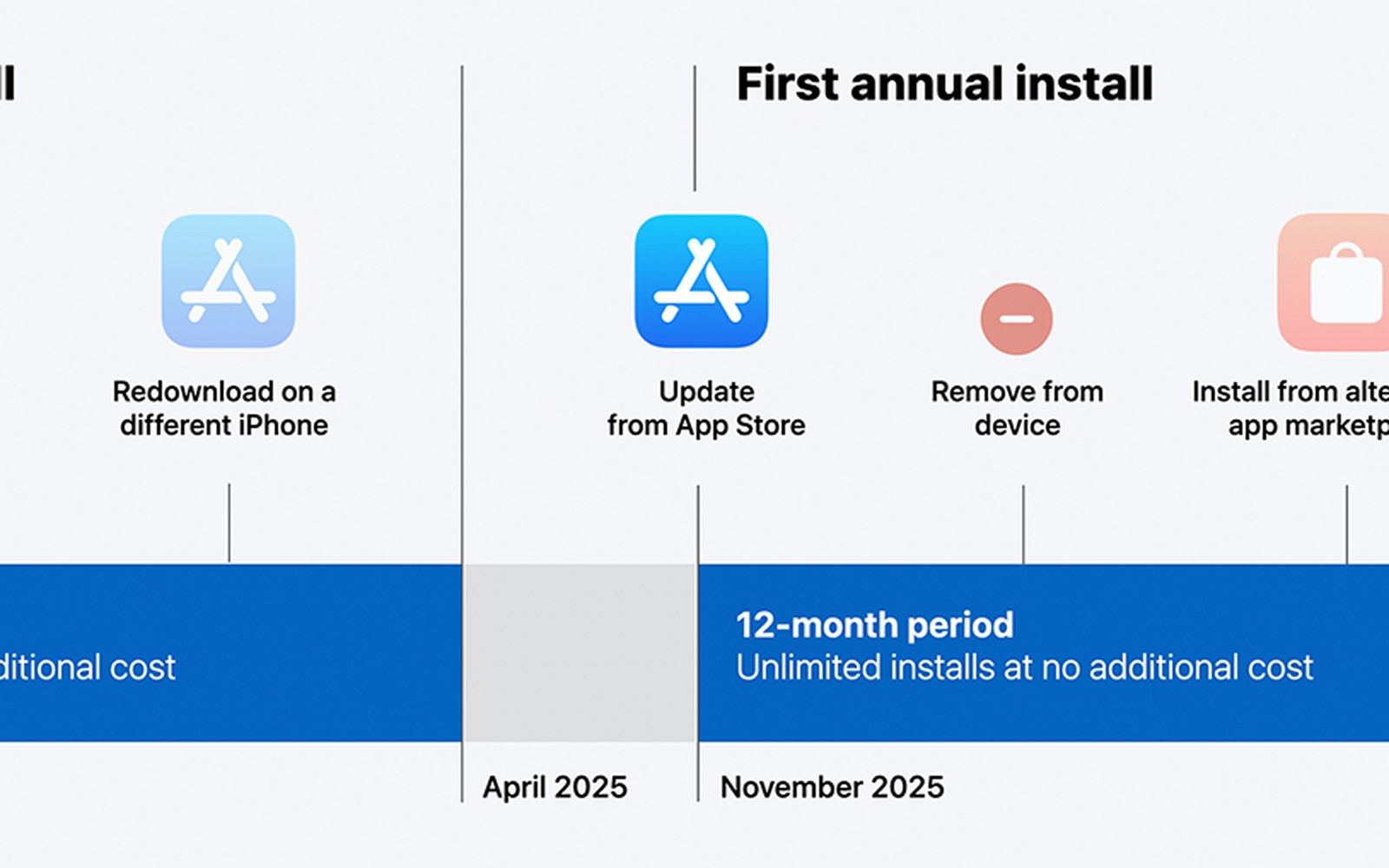
When Apple published its revised business terms for the EU in January 2024, the announcement was framed as compliance with the Digital Markets Act ↗, which required Apple to permit alternative app marketplaces and third-party payment processors on iOS for the first time. Buried inside that package was a charge Apple had invented from scratch: the Core Technology Fee, set at €0.50 for each first annual install of an app beyond one million, per year. The fee applies regardless of whether the developer uses Apple's payment system, and regardless of whether the install came through the App Store, an alternative marketplace, or direct sideloading.
Apple's rationale was published alongside the terms. The company described the fee as compensation for access to the "core technology" it provides — the operating system, APIs, developer tools, and the security infrastructure that underpins iOS. The framing positioned it as a platform access charge rather than a commission, distinguishing it from the 30 per cent (or 15 per cent for qualifying small developers) that applies to in-app purchases processed through Apple's own system. Developers who choose Apple's new business terms for EU distribution pay the Core Technology Fee alongside a reduced commission, in place of the old commission structure — or, optionally, they may remain on the old terms entirely, in which case the fee does not apply and neither does access to alternative marketplaces.

The threshold was set at one million first annual installs. Apple's published explanation specified "first annual installs," meaning re-downloads by the same account in the same year do not count toward the threshold or add to the charge. Free apps that never generate revenue are technically exposed to the fee once they cross the threshold, a design choice that drew immediate concern from developers with large user bases and no direct monetisation — social platforms, productivity tools distributed at no charge, open-source utilities.
Who It Hits, and the Arithmetic Problem
Apple has stated that more than 99 per cent of developers on the App Store would owe nothing under the Core Technology Fee, because the one-million-install floor sits well above the scale most developers reach. That framing is arithmetically defensible. What it elides is that the developers above the threshold are, almost by definition, the ones whose participation in an alternative ecosystem would carry the most competitive significance. A new entrant store needs popular apps to attract users; popular apps are precisely the ones exposed to the fee.
The arithmetic compounds quickly at scale. An app with five million EU installs in a year — modest by the standards of any top-quartile consumer app — would owe €2 million on those installs alone, before any consideration of payment commissions. An app at twenty million installs, a figure well within the range of major social, gaming or utility titles, would face a €9.5 million annual charge. Developers using Apple's new terms receive a reduced commission of 17 per cent (or 10 per cent for small developers and subscriptions after the first year) through Apple's payment system, and can negotiate their own payment rates elsewhere — but the fee runs beneath all of that, as a floor charge on distribution itself.
Chronology
- January 2024Apple publishes Core Technology Fee as part of its DMA compliance package
- March 2024DMA obligations take full effect; European Commission opens formal investigation into Apple's compliance
- June 2024Commission publishes preliminary findings citing Apple's new terms, including the fee, as potentially inconsistent with DMA requirements
- April 2025Commission issues €500 million fine against Apple; covers anti-steering rules, not the Core Technology Fee
Riley Testut, co-developer of AltStore and one of the first operators of an alternative app marketplace in the EU, published a detailed breakdown in early 2024 showing that AltStore PAL itself would, under certain growth scenarios, accumulate a meaningful Core Technology Fee liability despite generating minimal revenue. The calculation illustrated the structural tension: a store designed explicitly to offer free and open-source software could become financially untenable if it achieved meaningful scale.
Apple published a fee estimator tool alongside the business terms, allowing developers to model their exposure. The tool calculates liability based on projected installs but does not account for the compounding effect across multiple apps from the same developer, nor does it cap total liability.

The Commission's Position
The European Commission opened a formal investigation into Apple's compliance with the DMA in March 2024, the same month the regulation's obligations took full effect. Its preliminary findings, published in June 2024, identified several areas of concern, and the Core Technology Fee was among them. The Commission's position, as stated in those preliminary findings, was that Apple's new terms — including the fee — did not allow developers to benefit from the DMA's freedoms on terms that were genuinely more favourable than those available before the regulation came into force. In the Commission's framing, a compliance package that introduces a novel per-install charge alongside the new freedoms may not satisfy the DMA's requirement that gatekeepers enable developers to reach end users effectively and without disproportionate conditions.
The DMA's Article 6 obligations, which Apple's changes were intended to address, include requirements that gatekeepers allow third-party app stores, permit developers to use alternative payment processors, and not hinder effective switching. The Commission's preliminary view was that Apple had implemented these obligations in a way that steered developers toward the old terms rather than genuinely enabling the new freedoms. The Core Technology Fee, applied universally to alternative distribution regardless of payment method, was central to that finding.
The fee in numbers
Apple contested the preliminary findings, arguing that the new terms are voluntary, that developers retain the choice to remain on the old framework, and that the fee reflects real costs of platform access. The Commission's investigation remained open as of the dates of its published filings; the April 2025 fine of €500 million against Apple, issued by the European Commission, addressed a separate matter — the anti-steering restrictions on the App Store — rather than the Core Technology Fee specifically. The fee's legal status under the DMA has not yet been resolved by a final Commission decision.
The Design Logic and What It Reveals
The Core Technology Fee is, structurally, the kind of charge that can only exist because Apple controls both the operating system and the distribution layer. No regulatory framework before the DMA required Apple to permit alternative distribution, so no developer had ever needed to price the cost of iOS access separately from the App Store commission — those two things were the same thing. Once the DMA compelled Apple to unbundle them, Apple assigned a price to the layer it still controls entirely.
Whether that price is commercially reasonable depends on a calculation regulators have not yet completed. What the fee demonstrates is that platform economics do not simply reset when a court or a regulator orders a market to open. Apple's 30 per cent commission was never purely a payment-processing fee; it was always partly a charge for access to the user base, the distribution infrastructure, and the operating environment. The Core Technology Fee makes that underlying charge explicit and unbundles it from the transaction — which is either a model of transparency or a mechanism for preserving the economic status quo, depending on which party's filing you are reading.

The Commission's job, as the investigation proceeds, is to determine which of those descriptions the DMA's text actually supports.