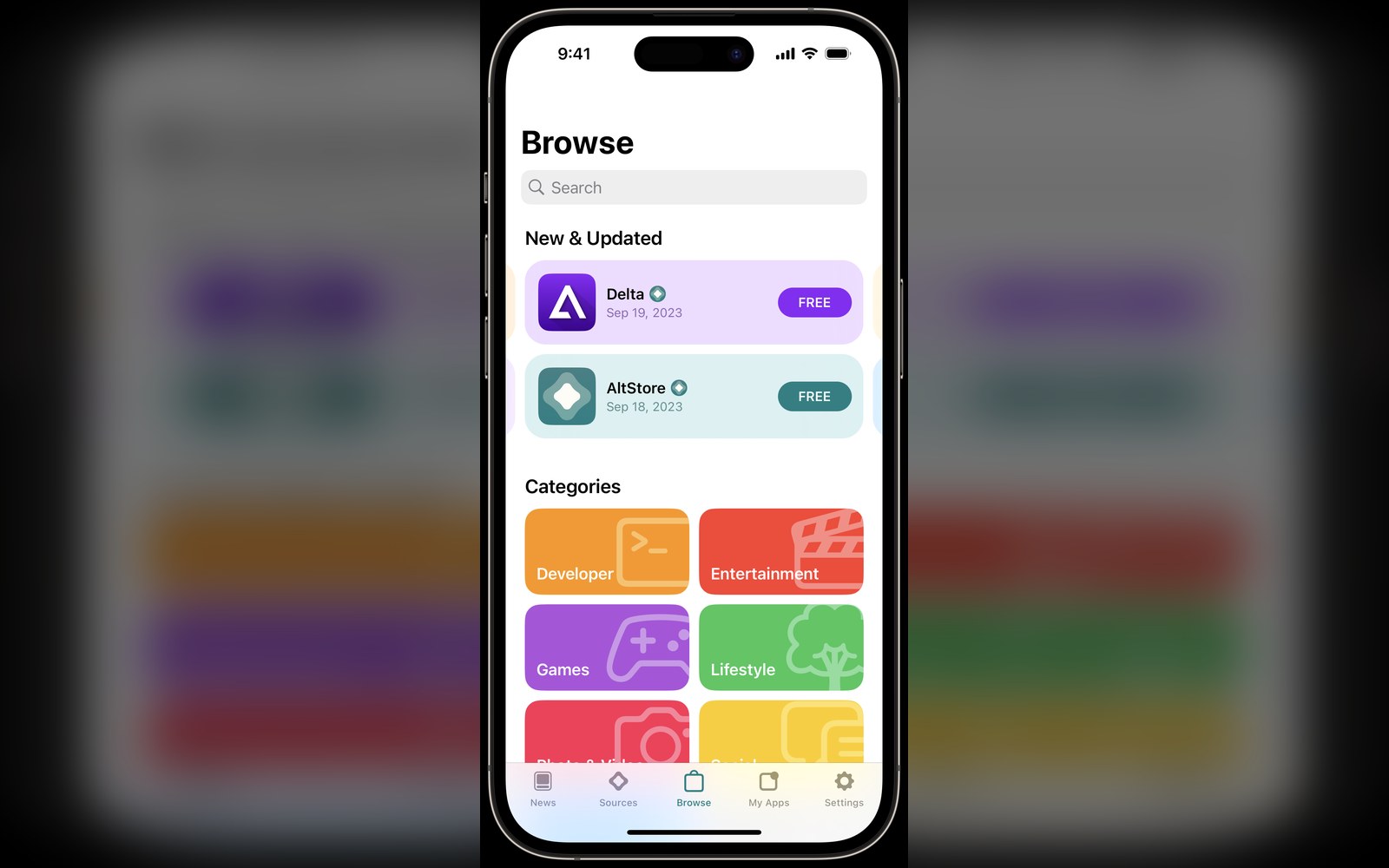
The First Alternative Marketplace to Test Apple's New Rules
When the Digital Markets Act's obligations became enforceable on 7 March 2024, Apple's response was not to open its platform but to redefine what "open" meant. AltStore PAL, a European version of the long-running AltStore project developed by Riley Testut and his collaborator Shane Gill, became the first alternative app marketplace to clear Apple's new requirements and begin distributing iOS apps outside the App Store in the EU — making it the clearest early test of what Apple's compliance actually permitted.
AltStore had existed for years as a workaround, allowing users to sideload apps onto iPhones via a desktop computer, exploiting a developer-certificate mechanism that Apple periodically disrupted. The EU version was different in kind: it was a formally recognised alternative marketplace operating under the DMA's framework, not a workaround. That legitimacy came with a condition Apple had designed itself.
Every app distributed through AltStore PAL — or any other alternative marketplace — must first pass Apple's notarisation process, an automated security review that Apple controls and can decline. Apple presented notarisation as a baseline safety check; critics, including developers and the European Commission in Brussels, characterised it as a gate Apple retained inside the gate it was nominally required to open. Notarisation does not replicate the full App Store review — it scans for known malware and checks certain technical requirements — but it gives Apple a continuing veto over what reaches EU iPhones through third-party channels.
AltStore PAL launched in April 2024, charging users €1.50 per year to cover what Testut described in the store's public announcement as the costs imposed by Apple's Core Technology Fee — €0.50 per install beyond one million annually. For a small independent marketplace with a niche catalogue focused on emulators and developer tools, the fee structure created an immediate commercial problem: AltStore PAL's own marquee application, the game emulator Delta, was free, meaning any significant download volume would generate fee liability with no corresponding revenue. The €1.50 annual subscription was a direct response to that arithmetic.
Chronology
- Pre-2024AltStore operates as a sideloading workaround using developer certificates, periodically disrupted by Apple
- 7 March 2024DMA obligations become enforceable; Apple's alternative marketplace framework takes effect
- April 2024AltStore PAL launches in the EU at €1.50/year, becoming the first alternative marketplace to open
What AltStore PAL revealed was the gap between the DMA's text and Apple's implementation. The regulation required Apple to allow alternative distribution; Apple's framework required marketplace operators to agree to new commercial terms, submit to notarisation, and accept liability for apps they distributed. Riley Testut's project was small enough to navigate those terms and launch quickly, but the conditions it documented — published openly in AltStore's own communications — gave regulators and larger developers a concrete record of what Apple's version of compliance looked like on the ground in the months after 7 March 2024.